1950
Turing formulates the Imitation Game
Alan Turing examines whether machines can think and proposes an observable conversation experiment. The paper still shapes debate about machine intelligence.
Twelve selected milestones trace the path from a research question to learned models, generative systems and tool-using agents. This is not a complete chronicle: it links to primary sources and keeps events separate from our interpretation.
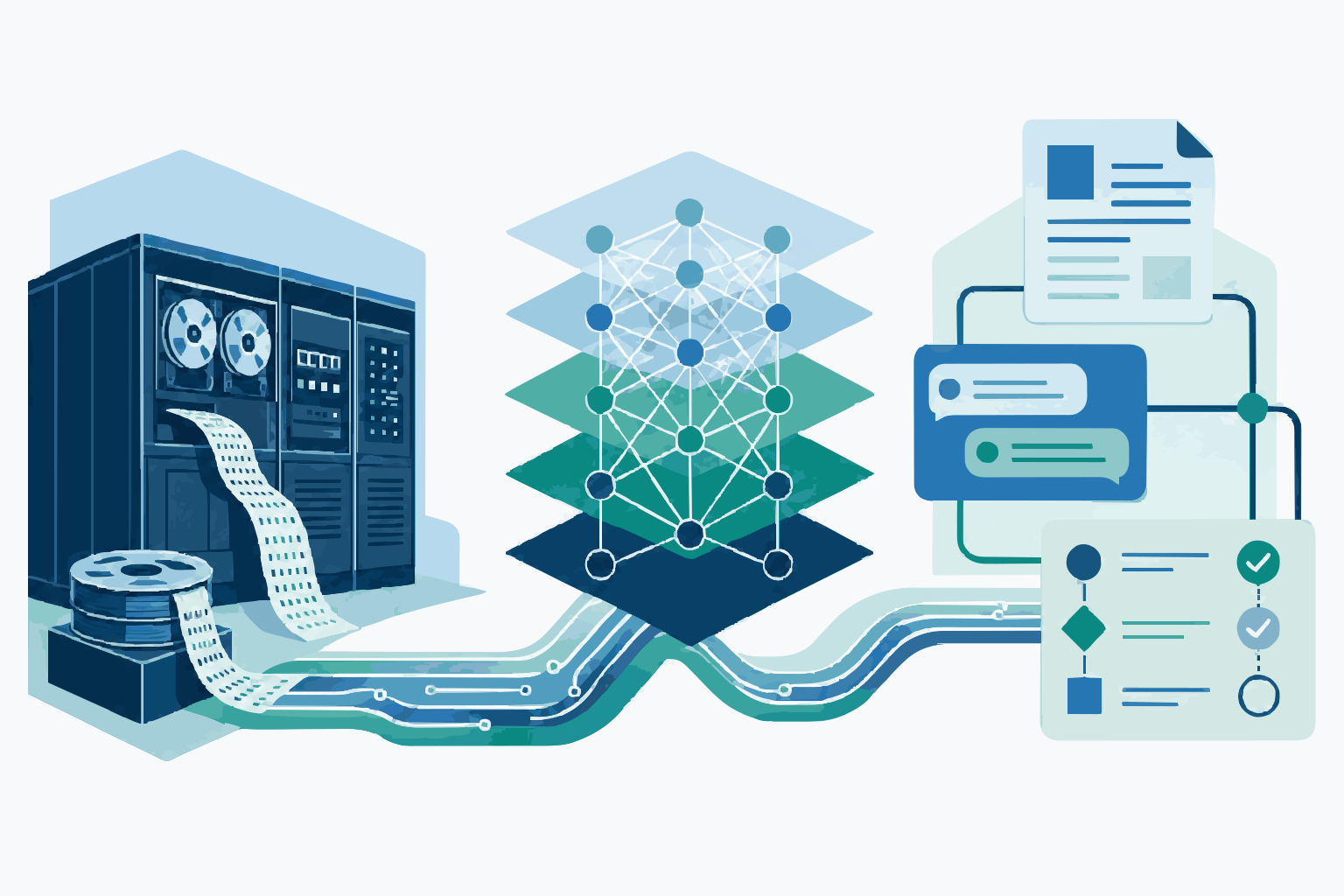
Scroll, drag or use the arrow keys to explore.Follow the milestones from 1950 to today.
Alan Turing examines whether machines can think and proposes an observable conversation experiment. The paper still shapes debate about machine intelligence.
The Dartmouth proposal uses the phrase “artificial intelligence” for a planned research programme. It marks an institutional starting point for the field.
IBM's chess system wins a match against reigning world champion Garry Kasparov. It relied on specialised search, evaluation functions and substantial compute — not today's language-model methods.
The published neural network achieves a decisive lead in the ImageNet competition. GPU training, large datasets and deep networks become central components of computer vision.
DeepMind's system wins the closely watched Go match 4–1. The underlying work combines neural networks with search and reinforcement learning.
“Attention Is All You Need” describes a sequence architecture without recurrent layers. The idea becomes an important foundation for later large language models.
OpenAI documents a 175-billion-parameter autoregressive language model and studies tasks performed from examples in the prompt rather than task-specific training.
OpenAI releases ChatGPT as a research preview. Its accessible dialogue interface lets a broad audience experience both the abilities and the limits of generative language models.
The technical report describes a model that can process image and text inputs and produce text. It publishes extensive evaluations, but not full architecture or training details.
Anthropic publishes the Model Context Protocol as an open standard for connecting AI applications to data sources and tools. A protocol alone does not solve permissions or quality assurance.
Microsoft's Work Trend Index describes a move from assistants towards human-agent teams. This is a vendor framework, not proof of maturity: production still requires evaluation, limited permissions, logging and clear human accountability.
Microsoft describes Agent 365 as a control and governance layer and makes Copilot Cowork generally available to Microsoft 365 Copilot customers. Licensing, data flows, model providers and regional availability must be checked for each use case.
We start with the process boundary, baseline, evaluation cases, human approvals and documented data flows — not an arbitrary agent demo.
Book a conversation